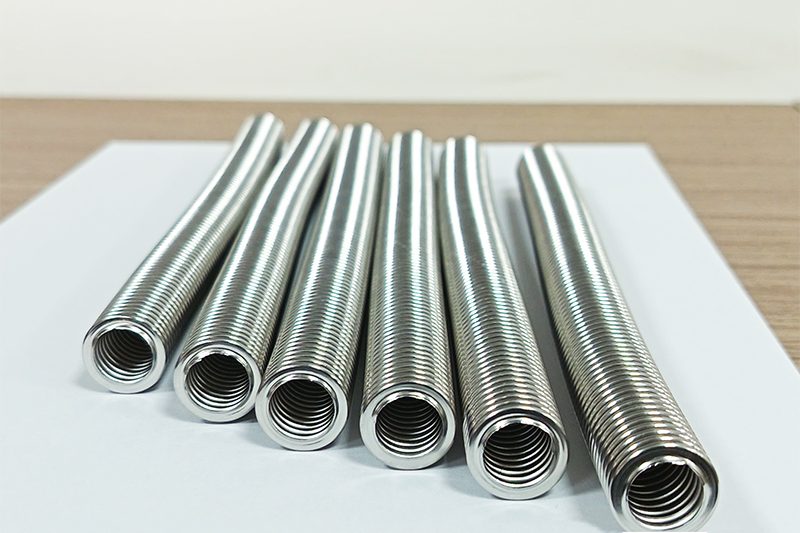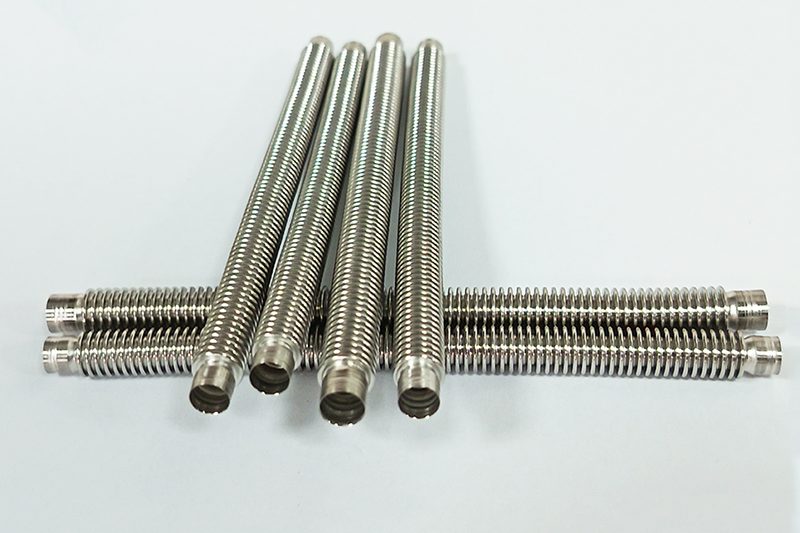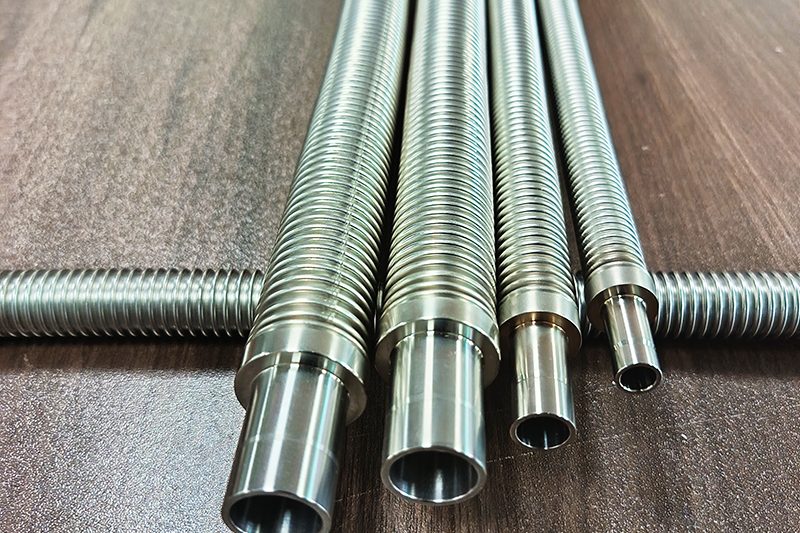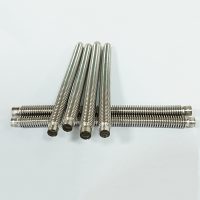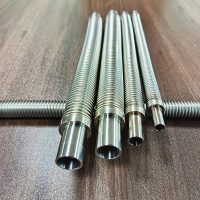
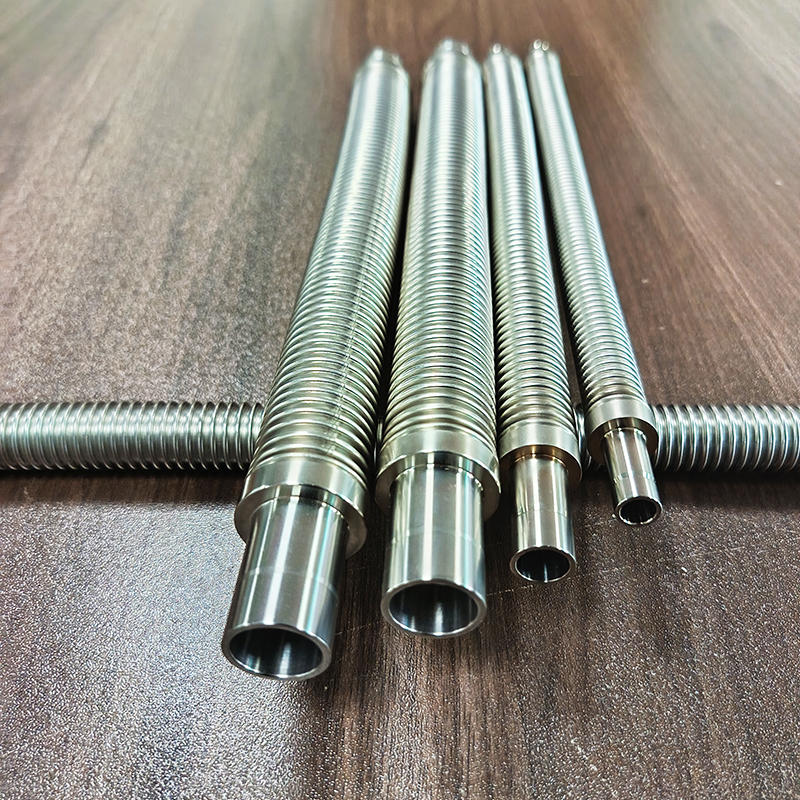
Edge‑welded (diaphragm‑welded) bellows are assembled by alternately welding thin stamped metal diaphragms at inner and outer edges, while hydro‑formed bellows are plastically expanded from seamless tubing by high‑pressure hydraulic fluid. Edge‑welded bellows deliver clear performance edges for precision, compact‑space, high‑cycle and ultra‑clean applications:
- Far Higher Stroke Efficiency & Compact Footprint
- Edge‑welded bellows can achieve ~90 % stroke relative to free length, versus roughly 20 % for hydro‑formed bellows.
- For the same required travel / volume compensation, edge‑welded units can be much shorter and lighter, ideal for cramped enclosures such as data‑center liquid‑cooling CDU hardware, semiconductor chambers.
- Uniform Wall Thickness & Lower, Tunable Spring Rate
- Hydro‑forming stretches tube material; convolution crests suffer material thinning (15‑30 % wall loss), creating uneven stiffness and stress hotspots.
- Edge‑welded bellows retain the original diaphragm sheet thickness across every convolution. Engineers can add or remove individual diaphragms to precisely tune spring rate, achieving very low spring stiffness with minimal hysteresis for precision motion compensation. Hydro‑formed bellows have inherently higher spring rates with limited adjustability.
- Superior Multi‑Dimensional Compliance
Edge‑welded bellows provide excellent axial compression, angular deflection and radial offset capability simultaneously. Hydro‑formed bellows are good for axial movement but show poorer angular‑radial flexibility under offset loads.
- Better Precision & Low‑Hysteresis Behaviour
Plastic deformation during hydro‑forming introduces work‑hardening and hysteresis (5‑12 % typical). Edge‑welded bellows operate mainly within elastic deformation limits, delivering near‑linear force‑displacement curves with minimal hysteresis, well‑suited for instrumentation, valve actuators and optical alignment systems.
- High‑Cycle Fatigue Performance
Uniform stress distribution across welded diaphragms yields excellent fatigue life for millions‑of‑cycles service. Hydro‑formed bellows tend to initiate fatigue cracks at thinned crest regions under repeated flexing. Multi‑layer edge‑welded constructions further boost pressure rating without sacrificing flexibility.
- Ultra‑High‑Vacuum & Ultra‑Low‑Leak Capability
All‑metal welded construction supports ultra‑low helium leak rates down to 1×10⁻⁹ std.cc/s, suitable for UHV semiconductor and aerospace environments. No polymer components eliminate out‑gassing risks. Hydro‑formed bellows are rarely qualified for strict ultra‑high‑vacuum service.
7. Broader Material Freedom
Edge‑welded bellows can utilise hard‑to‑form alloys (titanium, high‑nickel superalloys, tantalum) that cannot easily withstand the large plastic tube deformation required for hydro‑forming.