What Is Thermal Movement in Pipes?
When a pipeline heats up or cools down, the metal expands or contracts. The amount of movement depends on the pipe material, the length of the run, and the temperature change from the day it was installed.
A 50-meter carbon steel pipe heated from 20°C to 200°C, for example, grows by about 105 mm — roughly 4 inches.
If the pipe is free to move, this growth is harmless. But if it is fixed at both ends, the pipe cannot move and instead builds up enormous compressive stress.
That stress can buckle the pipe, crack flanges, or damage pumps, turbines, and other connected equipment. A bellows expansion joint solves this by absorbing the displacement mechanically.
How Does a Bellows Absorb Movement?
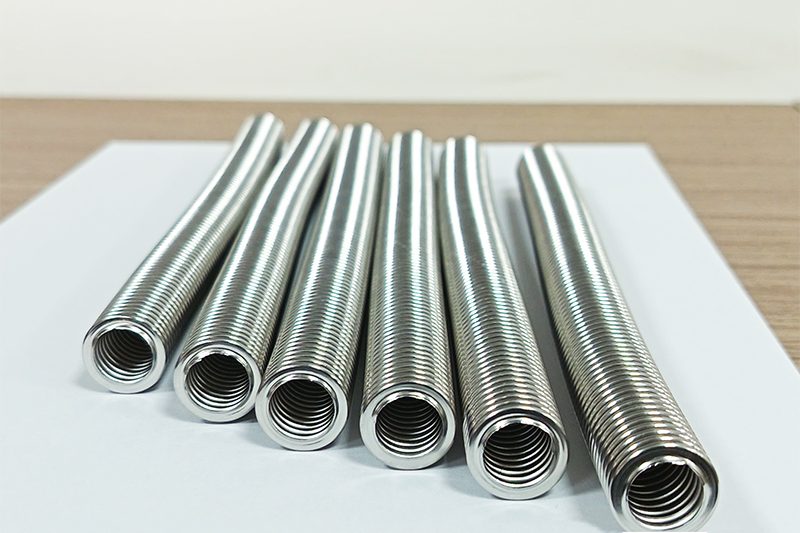
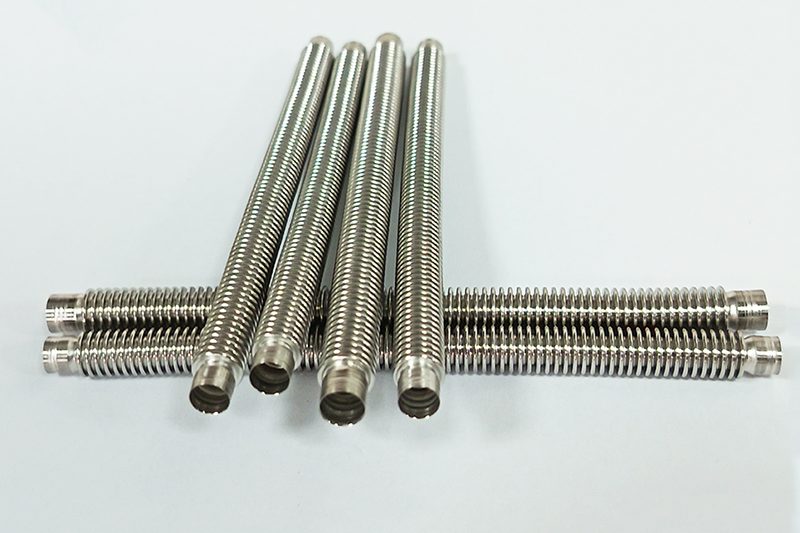
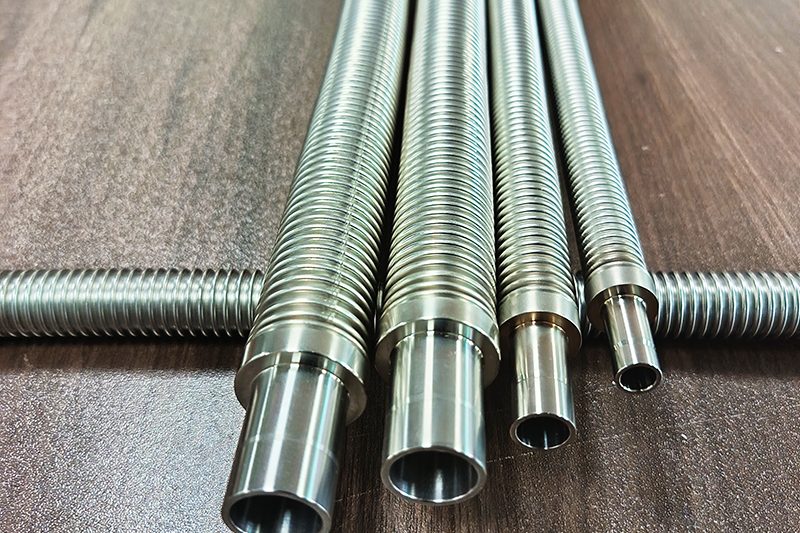
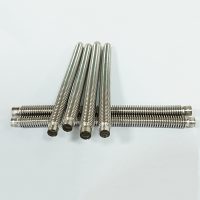
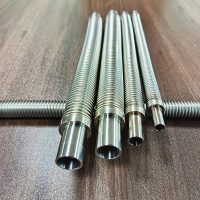
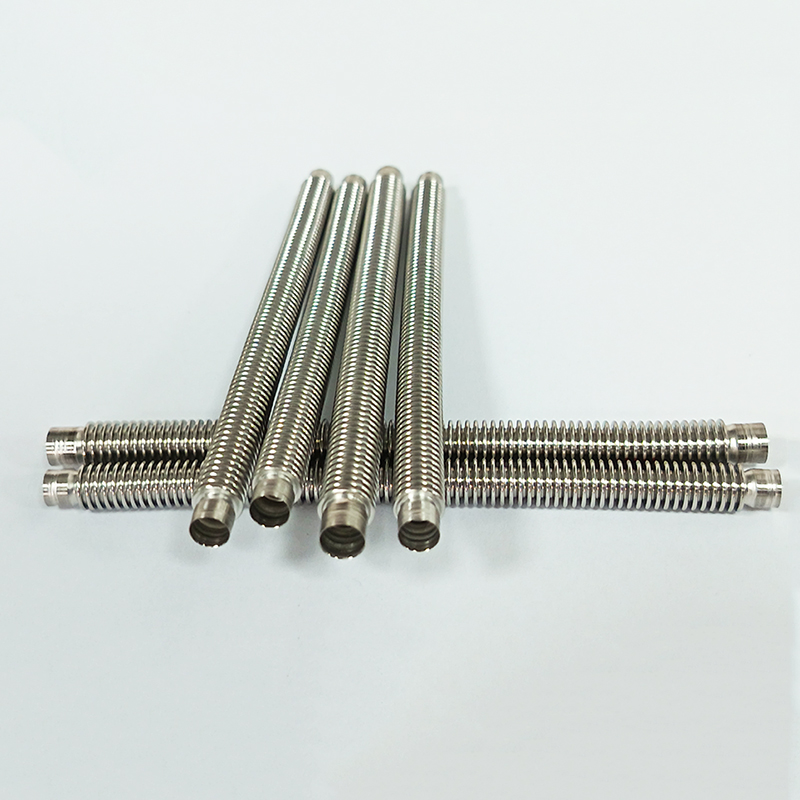
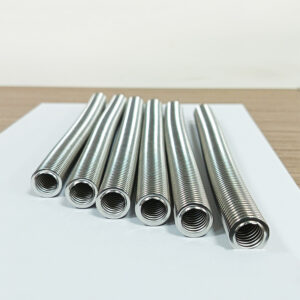
A bellows is a thin-walled cylinder formed into a series of convolutions, or corrugations. Each convolution acts like a flexible spring element.
Axial Compression and Extension
When the pipe expands, the convolutions compress. The gap between adjacent convolutions gets smaller.
When the pipe cools and contracts, the convolutions stretch back out.
The total axial capacity equals the number of convolutions multiplied by the allowable movement per convolution. The thin wall and curved shape allow large elastic deformation with relatively low resistance.
Lateral Offset
Convolutions on one side compress while the opposite side extends. This creates a sideways bending effect across the joint.
A single bellows can absorb only limited lateral movement. Universal joints — two bellows connected by a center pipe — handle much larger lateral offsets.
Angular Rotation
One side of the bellows compresses and the other extends, allowing the pipe to bend at the joint.
Hinged or gimbal joints are designed specifically for this type of movement.
What Types of Movement Can an Expansion Joint Handle?
| Movement Type | Description | Joint Type Required |
|---|---|---|
| Axial | Along the pipe centerline — compression or extension | Single axial expansion joint |
| Lateral | Perpendicular to the pipe axis — sideways offset | Universal, double bellows, or tied universal |
| Angular | Rotation in one plane — bending | Hinged joint |
| Universal angular | Rotation in any plane — 3D bending | Gimbal joint |
| Combined | Axial + lateral + angular at the same time | Pressure-balanced or universal with hardware |
Common Expansion Joint Configurations
Single Axial Joint
A single axial joint contains one bellows element with no restraining hardware.
It absorbs only axial movement. Internal pressure creates a thrust force that pushes against the anchors, so heavy main anchors are required at both ends.
Universal Joint (Double Bellows)
A universal joint uses two bellows separated by a center pipe, also called a spool piece.
It absorbs large lateral movement plus some axial and angular movement. The center pipe acts as a lever, so small convolution deflection translates into a large lateral offset.
It still transmits pressure thrust to anchors unless fitted with tie rods.
Tied Universal Joint
A tied universal joint adds tie rods that span both bellows.
The tie rods contain the pressure thrust, so no main anchors are needed — only pipe guides.
It absorbs lateral and angular movement. Axial movement is restrained by the tie rods. This is the most common configuration for long, straight pipe runs.
Hinged Joint
A hinged joint fits the bellows with a hinge mechanism of pins and side plates.
It absorbs angular rotation in one plane only. The hinge contains the pressure thrust.
Hinged joints are typically used in pairs or triplets — two-hinge or three-hinge systems — to handle complex movement patterns.
Gimbal Joint
A gimbal joint fits the bellows with a two-axis pivot assembly.
It absorbs angular rotation in any plane. The gimbal contains the pressure thrust.
It is used where three-dimensional angular movement is expected.
Pressure-Balanced Expansion Joint
A pressure-balanced joint combines a line bellows with a balancing bellows of equal effective area.
Internal pressure acts on both bellows in opposite directions, canceling out the pressure thrust.
This allows axial movement without transmitting thrust to connected equipment such as pumps, turbines, or compressors. It is used specifically to protect sensitive equipment nozzles from excessive loads.
It is more complex and more expensive, so it is typically installed only at equipment connections.
Why Anchors and Guides Matter
Pressure Thrust — The Critical Force
Internal pressure acts on the bellows effective area, creating a force that tries to pull the joint apart.
This force depends only on the operating pressure and the bellows size. It does not depend on how flexible the bellows is.
A DN200 (8-inch) pipe at 16 bar (232 psi), for example, generates roughly 72,000 Newtons of thrust — about 16,000 pounds of force. Even a perfectly flexible joint transmits this full force.
Pressure thrust must be contained by one of the following:
Main anchors for untied joints
Tie rods, hinges, or gimbals for restrained joints
A balancing bellows for pressure-balanced joints
Spring Force
The bellows itself resists deflection with a spring-like force proportional to how far it is compressed or extended.
This force is usually much smaller than pressure thrust — often 1 to 5 percent of it. But it still loads the pipe and connected equipment, so it must be accounted for in the design.
The Complete Compensation System
A bellows expansion joint does not work alone. The piping system needs supporting hardware.
| Component | Function |
|---|---|
| Main anchor | Resists pressure thrust, spring force, and friction |
| Intermediate anchor | Divides long pipe runs into controlled segments |
| Pipe guide | Allows axial movement while preventing sideways buckling |
| Limit stop | Prevents over-extension during hydrotest or system upset |
| Bellows | The flexible element that absorbs the actual displacement |
A typical layout for a single axial joint looks like this:
Anchor — pipe — guide — bellows — guide — pipe — Anchor
Guides are spaced according to EJMA or manufacturer standards to prevent the pipe from buckling like a column under compressive load.
Key Design Standards
EJMA (Expansion Joint Manufacturers Association) — the dominant global standard for metallic bellows expansion joints, covering stress analysis, fatigue life, spring rates, and guide spacing.
ASME B31.3 — process piping code, which references EJMA for expansion joint design.
EN 14917 — European standard for metallic bellows expansion joints.
GB/T 12777 — Chinese standard for metal bellows expansion joints.
Summary
Bellows expansion joints compensate for thermal movement by using flexible convolutions that deform elastically.
They compress, extend, or deflect sideways or angularly — instead of forcing the pipe to absorb the stress.
The real engineering challenge is not the flexibility itself, but managing pressure thrust. Every joint must either be anchored, restrained with hardware such as tie rods or hinges, or pressure-balanced.
This ensures that the huge internal-pressure force does not damage the pipeline or connected equipment.