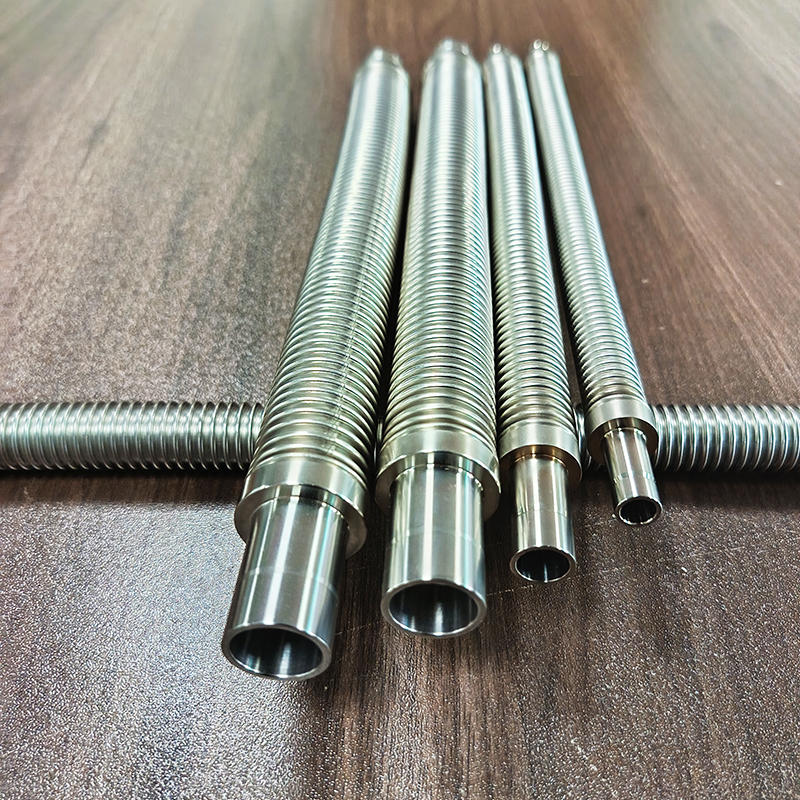
Core Keyword: Hydro-Formed vs Edge-Welded Bellows
Secondary Keywords: metal bellows types, hydroformed bellows benefits, edge-welded bellows applications, industrial bellows selection, flexible metal expansion joints
When designing industrial fluid systems, vacuum equipment, precision instrumentation, or mechanical motion assemblies, choosing the right metal bellows directly impacts system durability, movement accuracy, cycle life, and overall operational costs. Hydro-formed bellows and edge-welded bellows are the two most common metal bellows types used across global industrial sectors. While both deliver flexible sealing, pressure compensation, and thermal expansion absorption, their manufacturing processes, structural characteristics, mechanical performance, and ideal use cases differ dramatically.
This guide breaks down the critical differences between hydro-formed and edge-welded bellows to help engineers, procurement teams, and system designers select the optimal solution for their specific project requirements.
- Core Manufacturing Process Differences
The fundamental gap between the two bellows types stems from their entirely distinct production methods, which lay the foundation for their unique performance traits.
What Are Hydro-Formed Bellows?
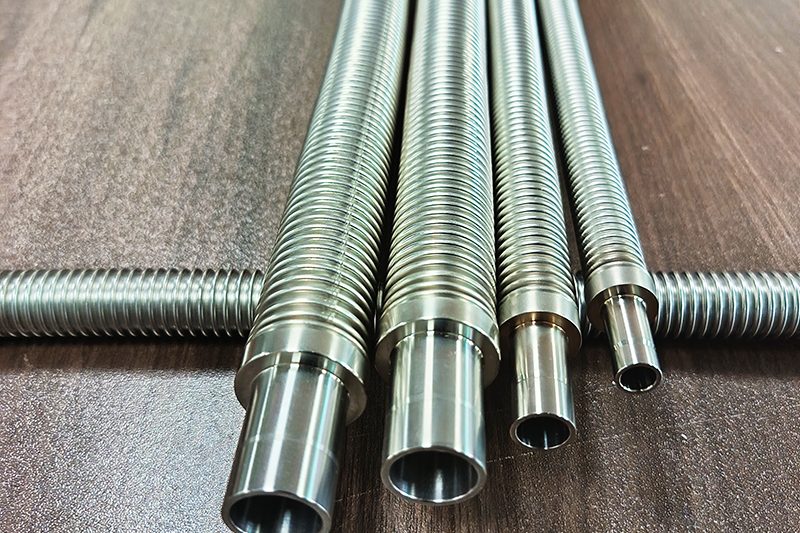
Hydro-formed bellows (also called hydraulically formed bellows) are manufactured from seamless or seamed metal tubing. The production process uses high-pressure hydraulic fluid paired with precision dies to radially expand and deform the tube wall, forming continuous, uniform convolutions in a single molding step .
This is a cold-forming process that reshapes the original metal tube without welding. The entire bellows body is an integrated one-piece structure, with consistent material continuity across all convolutions. It is highly suitable for automated mass production with standardized dimensions.
What Are Edge-Welded Bellows?
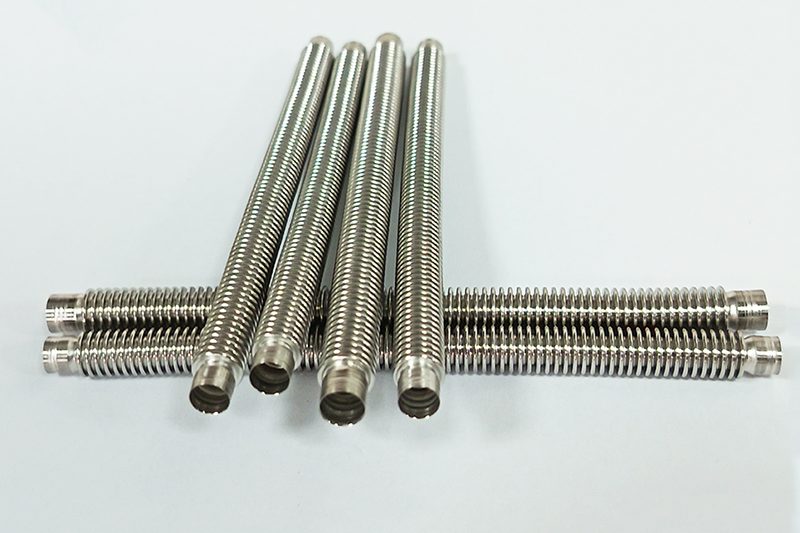
Edge-welded bellows (diaphragm bellows) are assembled components rather than single-piece molded parts. Manufacturers first stamp thin, flat metal sheets into individual ring-shaped diaphragms. These standalone diaphragms are then stacked and precision-welded along their inner and outer edges to form continuous convolution structures .
Each convolution is an independent diaphragm unit connected by micro-weld seams. This welding-based manufacturing method enables ultra-thin wall designs and customizable convolution heights, sizes, and pitches that hydro-forming cannot achieve. - Structural & Mechanical Performance Comparison
Manufacturing differences create huge disparities in wall thickness, flexibility, stroke capacity, stiffness, and fatigue resistance—the key performance metrics for industrial bellows.
Stroke Capacity & Flexibility
Edge-welded bellows deliver far superior flexibility and stroke performance. Industry test data shows edge-welded bellows can achieve a stroke of up to90% of their free length, while standard hydro-formed bellows only reach approximately 20% of free length stroke .
Thanks to their thin diaphragm structure and independent convolution design, edge-welded bellows easily handle axial, lateral, and angular multi-directional displacement. They maintain stable flexibility even in compact installation spaces . Hydro-formed bellows feature thicker tube walls and integral molding structure, resulting in higher stiffness and limited flexible movement range.
Stiffness & Hysteresis Performance
Hydro-formed bellows have high structural stiffness due to thicker wall sections. This makes them resistant to deformation under medium pressure but prone to obvious spring hysteresis during repeated telescopic movement, which affects precision calibration .
Edge-welded bellows adopt uniform thin diaphragms with evenly distributed stress. They exhibit nearly zero hysteresis, with spring rate variation controlled below 2% even after 500,000+ load cycles. This ultra-stable performance is irreplaceable for high-precision instrumentation applications .
Pressure Resistance & Cycle Life
The one-piece hydro-formed structure has no weld seams, eliminating weld defect risks. It boasts excellent pressure resistance, structural stability, and strong fatigue resistance under medium-to-high pressure working conditions, with a long service life in conventional industrial circulating systems.
Edge-welded bellows are restricted by weld seam strength, making them more suitable for low-pressure, vacuum, and micro-pressure environments. High-pressure scenarios may accelerate weld seam fatigue and reduce cycle life . - Material Availability & Customization Flexibility
Material adaptability is another key distinction affecting application scope.
Hydro-formed bellows rely on tube plastic deformation, so they are limited to highly ductile metals that can withstand hydraulic stretching. Common materials include 316L stainless steel and 304 stainless steel. Brittle or low-ductility metals cannot be used for hydro forming .
Edge-welded bellows have broader material compatibility. Since the process involves stamping and welding instead of integral stretching, it supports diverse high-performance materials including 316, 321, 347 stainless steel, AM 350 alloy, Grade 2 titanium, and Hastelloy high-temperature alloys . This makes them ideal for extreme working conditions such as corrosion, high temperature, and ultra-high vacuum.
In terms of customization, edge-welded bellows support arbitrary adjustments of convolution quantity, pitch, and diaphragm thickness for ultra-short or ultra-long stroke customization. Hydro-formed bellows are limited by mold specifications, with relatively single customizable parameters. - Cost & Production Efficiency
Cost differences determine the cost-performance ratio for mass production and small-batch customized projects.
Hydro-formed bellows require high upfront mold tooling costs, but the automated one-step forming process delivers fast production speed and low unit cost for large-batch standardized orders. They are the most cost-effective choice for conventional standard industrial bellows .
Edge-welded bellows involve complex stamping, trimming, and precision welding processes with low automation efficiency and high labor and processing costs. No high mold investment is needed, making them suitable for small-batch, high-precision, customized orders, but their unit price is significantly higher than hydro-formed bellows for mass production . - Typical Industrial Applications
Their performance and cost characteristics dictate their respective best-fit application scenarios.
Best Applications for Hydro-Formed Bellows
- General industrial pipeline thermal expansion joints
- Medium-pressure fluid conveying systems (water, oil, gas)
- Standard mechanical sealing and vibration damping structures
- Large-batch, low-cost standardized industrial equipment
Best Applications for Edge-Welded Bellows - High-precision instrumentation and sensor calibration systems
- Ultra-high vacuum and high-purity gas equipment (semiconductor, aerospace)
- Micro-displacement and multi-directional motion compensation devices
- Corrosive, high-temperature, and extreme working condition equipment
- Compact space-constrained mechanical assemblies requiring long stroke
- Quick Comparison Table: Hydro-Formed vs Edge-Welded Bellows
Comparison Item
Hydro-Formed Bellows
Edge-Welded Bellows
Manufacturing Process
One-piece hydraulic tube forming, no welding
Stamped diaphragms + edge precision welding
Max Stroke Ratio
~20% of free length
Up to 90% of free length
Stiffness & Hysteresis
High stiffness, obvious hysteresis
Low stiffness, near-zero hysteresis
Material Range
Limited to high-ductility metals
Wide range (stainless steel, titanium, high-end alloys)
Pressure Suitability
Medium to high pressure
Low pressure, vacuum, micro-pressure
Cost Feature
High tooling cost, low mass production unit price
No mold cost, high customized unit price
Core Advantage
Integral strength, low cost for mass production
High flexibility, high precision, strong customization
Final Verdict: How to Choose the Right Bellows
Choose hydro-formed bellows if you need cost-effective, high-strength expansion joints for standard medium-pressure pipeline systems, conventional industrial vibration damping, and large-batch standardized projects. It delivers stable basic performance with the best economic benefit.
Choose edge-welded bellows if your project requires high precision, long stroke, multi-directional flexible movement, ultra-high vacuum sealing, corrosion resistance, or customized special specifications. It is the premium solution for high-end precision industrial and aerospace applications.